
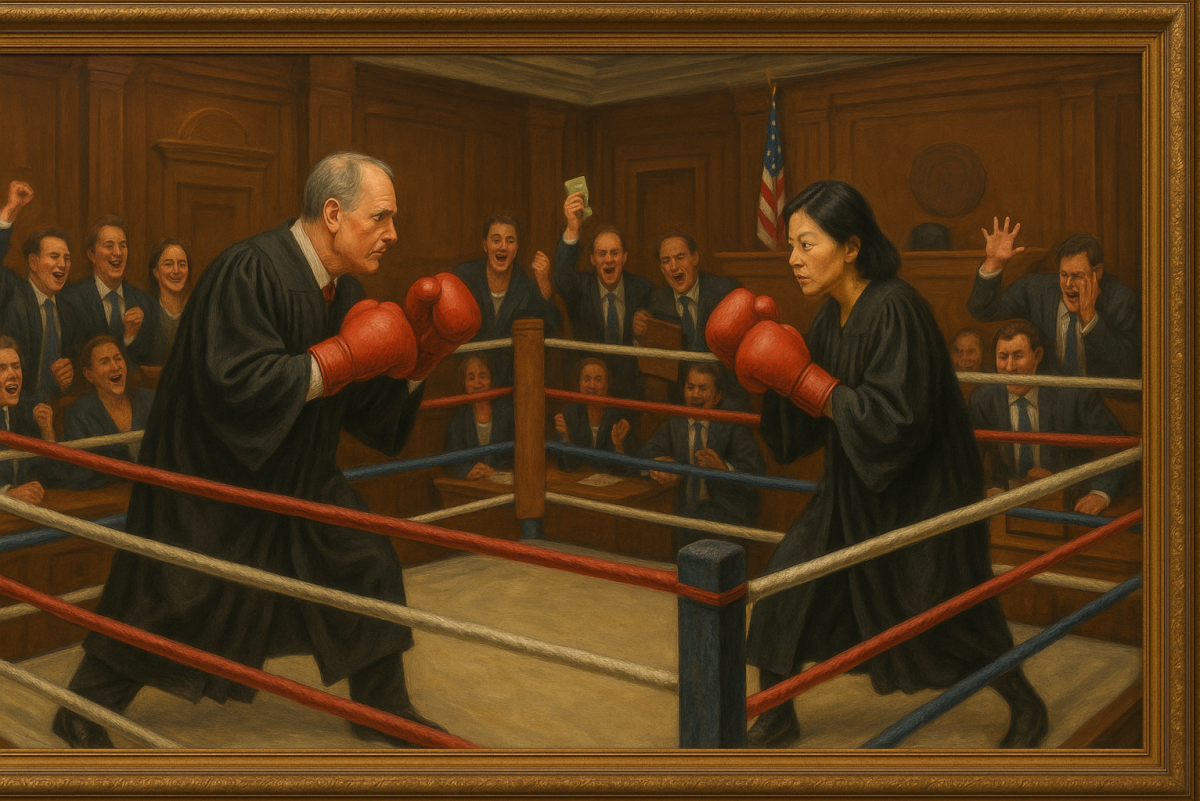
Today marks my first chance to post this week. So I wanted to highlight some free-speech or free-speech-adjacent issues.
• An en banc Ninth Circuit overruled precedent and held that denial of an anti-SLAPP motion (under California’s statute) is not immediately reviewable under the collateral order doctrine. Notably, the majority opinion occupied 15 pages. The rest of the 48 pages consist of a two-judge concurrence defending the Ninth Circuit’s position that SLAPP statutes apply in federal court (the Ninth Circuit being on the short end of a lopsided circuit split) and a four-judge concurrence in the judgment arguing the court should overrule its entire SLAPP jurisprudence and hold the statutes do not apply in federal court.
I include this in a post on free-speech because this opinion is going to anger the speech community, which rightly sees SLAPP statutes (especially California’s strong one) as a key weapon against abusive defamation actions. But the answer, as the second concurrence argues, is not to create gaps in the FRCP. The answer is a federal SLAPP statute (which, unfortunately, will not happen). Or a state should enact a stand-alone fee-shifting provision (awarding fees when defendant wins, not only when defendant prevails on the SLAPP motion); that applies in federal court and should, along with Twiqbal, stop most abusive suits.
• Ari Kelvin (Stanford Education) argues in Arc that we cannot eradicate or eliminate antisemitism and should not try; he captures a lot of what I have been thinking about and trying to say on this. Two points of note. He argues that the demand for “zero tolerance” causes us to conflate and respond with identical outrage to “[c]ritiques of Israel, wild conspiracy theories, rants about the Rothschilds, teachers scheduling exams on Jewish holidays, baristas wearing “Free Palestine” buttons.” And argues, as others have, that “the fantasy that antisemitism can be driven down to zero has allowed American politicians to use antisemitism as an excuse to pummel American higher education, punish students, and bully faculty.”
Kelvin does not mention free speech, but everything in free-speech theory undergirds his point. The First Amendment allows people to hold and express hateful ideas and prohibits government from silencing or legislating away expression of those ideas. Demanding government do so produces dragnets that capture too much speech and cripple Jews’ ability to fight (with “more speech”) genuine antisemitism. As he concludes: “We live in a hateful world, and American Jews would do well to get used to it.”
• The NFL selected Bad Bunny to perform at halftime of the Super Bowl, angering MAGA bigots in and out of the Administration, who do not realize that Puerto Rico is part of the United States and that Bad Bunny is a citizen. Kristi Noem is talking about sending ICE agents to the game and limiting attendance only to good American citizens.
But people believe they have a new argument: Mr. Bunny did not stand during God Bless America during the Seventh Inning Stretch at Yankee Stadium in Wednesday’s ALDS game. Speaking as someone who does not stand when the song is played, I say good for him. GBA is not the national anthem and so observance obligations (which are not enforceable anyway) do not apply. It was written by someone who came to America and became a citizen due to Woke immigration policies. The song sucks. And it has no historic place at baseball games, certainly not during the stretch.
Anyway, I hope this discussion finally shuts up the “keep politics out of sports” people.
• An upcoming moot court competition (in which two FIU teams will compete) includes the following issue: Can the government fire someone over pre-employment speech, with a sub-issue of whether the court applies Pickering or a straight retaliation/Mt. Healthy analysis. Applying Pickering could chill public discourse–everyone would reduce their speech to what can survive a Pickering analysis, unsure of whether they someday might seek or hold public employment. A side question that occurred during a practice round: How would the court analyze a failure-to-hire claim (which, by definition, involves pre-employment speech)?
Thoughts?