
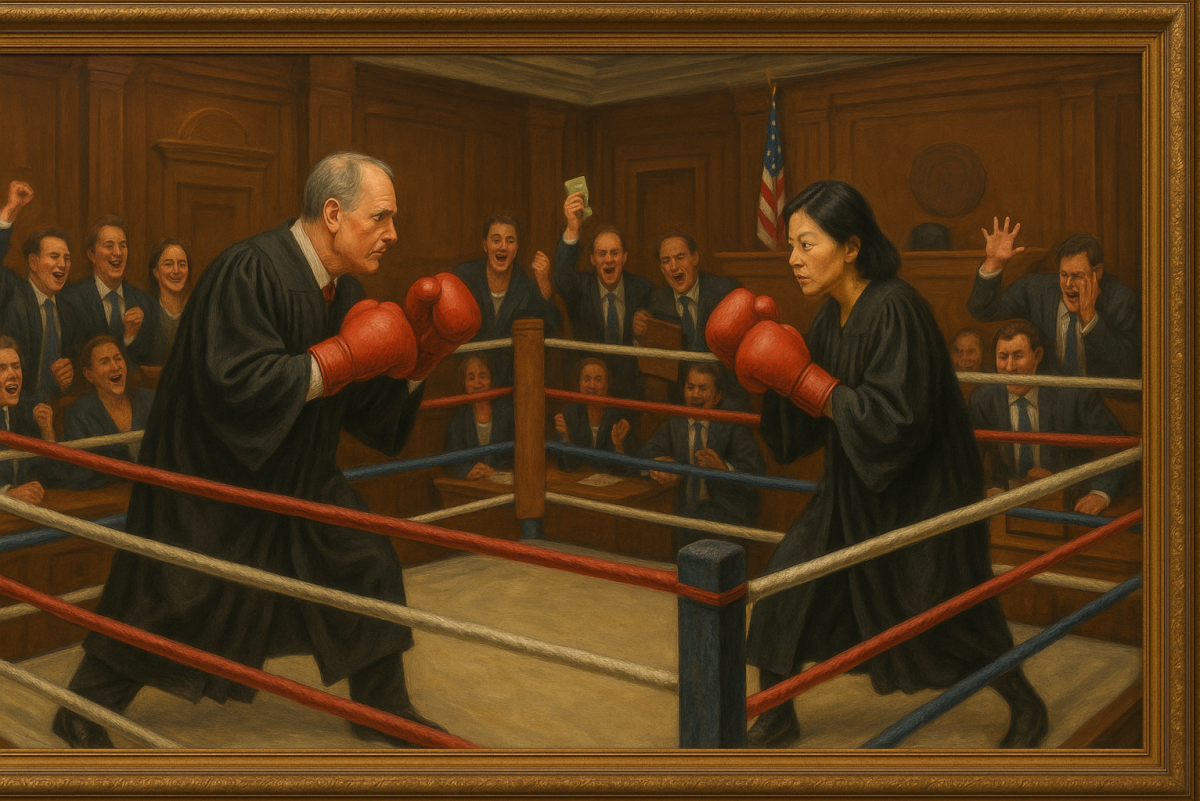
Judge Merryday (M.D. Fla.) sua sponte struck the absurd complaint in Trump’s absurd $ 15 billion lawsuit against the Times over its endorsement of Kamala Harris. The court called out Trump’s attorneys for filing an 85-page, 156-paragraph complaint for a simple two-count defamation action, larded with “many, often repetitive, and laudatory (toward President Trump) but superfluous allegations,” “persistently alleged in abundant, florid, and enervating detail.” The court granted leave to amend, but limited the complaint to 40 pages.
Many are celebrating this as the latest lower-court repudiation of Trump’s censorship efforts. I want to tap the brakes a bit.
I applaud the judge for using an available weapon to stop pleading-as-press-release. And, as with so much from Trump’s lawyers, this takes it to another level because the extraneous nonsense is intended less for the public than for Trump as audience-of-one. I wish more judges would do this. And I suppose Merryday took the step in this case because everyone is watching. And perhaps he wanted to signal his views on the merits of the pleading, hoping the attorneys will give up the ghost.
On the other hand, the order gets it wrong under (what I would argue) the best understanding of the Federal Rules. It discusses the purposes of Rule 8 and how the complaint fails to provide a short and plain statement of the claim. But Rule 12(f) does not enforce Rule 8; it targets “redundant, immaterial, impertinent, or scandalous matter.” That would cover much of the extraneous crap the attorneys included, but based on the language of Rule 12(f), not Rule 8. The remedy should be to strike the improper allegations while leaving the rest of the pleading in place (rather than striking the entire document). Although perhaps it makes sense in this case to place the onus on the plaintiff to separate the wheat from the chaff, given that the latter comprises most of the pleading. Alternatively, the court could use Rule 12(e), because the complaint is “so vague or ambiguous that the party cannot reasonably prepare a response;” this has come to cover “prolix” pleadings that include extraneous information. The plaintiff must file a complete new, less-vague pleading, again by dropping the extraneous nonsense that makes the complaint impossible to understand.
Rule 8 or the short-and-plain-statement requirement remains irrelevant to either mechanism, which relies on a distinct standard. The discussion of Rule 8, while funny (“hey, short means short”), is beside the point.
Moreover, if the pleading is as bad as the court suggests (it is), it might have brought Rule 11 into play. The obvious effort to stroke Trump’s ego with unnecessary and irrelevant detail could constitute an improper purpose, as well as increasing the cost and burden to the defendants in attempting to respond. Courts refuse to drop that hammer on lawyers who refuse to say no to Trump and who abuse the legal system on his behalf.
Update: One more thing: There is an argument (someone on the Civ Pro Prof Listserv suggested it) that this move plays into Trump’s hands, by giving the appearance (to those who do no know the law) of (yet another) judge out to get Trump. And the court could have waited for the inevitable 12(b)(6) motion and dismissed at that point, rather than reaching out. A fair point, although I doubt it matters to Trump’s most fervent supporters.