
In a newly relevant post over the summer, I discussed the degree to which a president who uses executive power openly and deliberately to engage in partisan, political, and now essentially literal civil war against substantial parts of the country based on who they voted for deprives himself of his primary claimed basis for legitimate national authority (that he is elected by and serves “the whole American people”). In that post, I wrote that “most of the interesting developments in constitutional law in the last few weeks, especially those involving separation of powers and unitary executive ‘theory,’ have had little or nothing to do with the Supreme Court.” That was just a few weeks after the end of the last term of the Supreme Court and my view very much took account of the Court’s usual flurry of June decisions and still found them less important than what was going on elsewhere.
Whatever your views on the judicial role in interpreting the Constitution and on the ultimate question of judicial supremacy, that is largely how it should be. We do have three branches of federal government, after all, and all of the officials in all three branches (not to mention officers of the states) are bound by oath and by necessity to interpret the Constitution. (All of them. The oath being an indefeasible individual pledge, executive branch officials cannot, in the crunch, delegate that authority to the president, although they can resign, or be dismissed for refusing to act in violation of the law and the Constitution. That dismissal, in turn, can be an impeachable offense, however hypothetically.) It is certainly how it generally is.
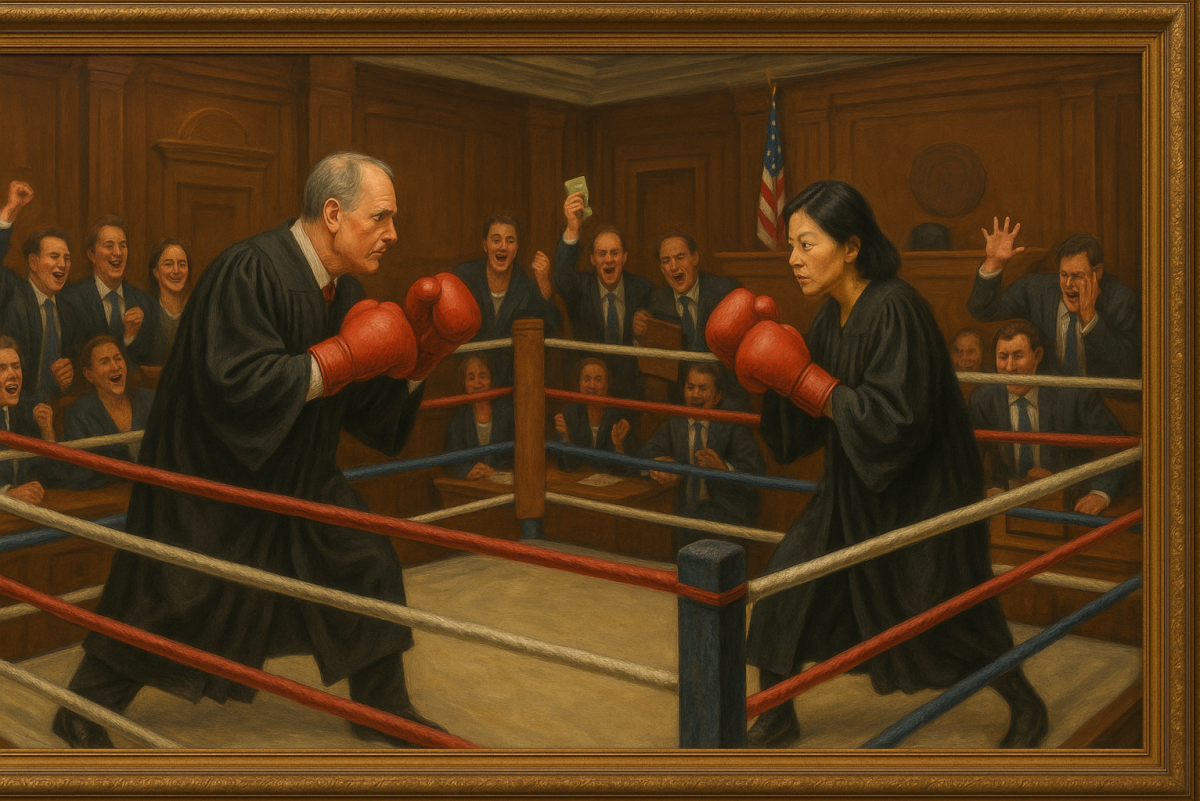
Today the Court’s period of what is no longer a summer vacation ends and the October Term 2025 begins. And it remains the case that the Court is currently the least important actor in American constitutional law. The executive branch, at present, remains the most significant, albeit in roughly the sense that a nuclear bomb can be a significant form of urban development. Congress is arguably tied for most significant, albeit roughly in the sense that a father who announces that he’s going to the store for a pack of smokes and never comes back is a significant figure in the life of a family. The federal courts bring up the rear, with the lower courts figuring more significantly than the Supreme Court itself. (That is a statement about their level of activity, not the correctness of the many lower court decisions.)
One might offer a few observations about this. The first is that it is closer to inevitable than to extraordinary, but with some nuances involved based on the temperature of the times and the relations between branches. In what we might think of as ideal but perfectly attainable circumstances, constitutional law developments are mostly placid, interstitial, incremental, and distributed among the branches. If the Supreme Court is the most visible and significant constitutional law actor during such a period, it’s not because it’s doing big things but because no one is, or because the most significant departures from the Constitution are being undertaken by state or local actors and addressed by the Court. (Think Texas v. Johnson, or a good deal of criminal procedure.) The system and its actors should be dispositionally conservative. (This is a problem in our era, in which neither political party is conservative, and conservatism itself is largely a dead letter within most soi-disant conservative intellectual circles.) Even in more extraordinary times, as in the height of the civil rights era, the story is as much about legislation and presidential action as it is about major court decisions. We should mostly want a boring Court for the same reason we should want a boring president and a boring (but not absent) Congress: because ordinary, stable constitutional government is a positive good. The machine should go of itself at a smooth pace, neither stopping nor sprinting.
Second, much of the constitutional “action” at any given time, and the basis for boring and stable government, is sub- or quasi-constitutional. It depends not on major statements or restatements of the law of the Constitution, but on the branches acting within the ordering space provided by basic background norms and customs. Among the many signal failures of the Biden administration was its failure to devote its four years to shock-proofing those norms, with as much congressional involvement as it could secure. That’s what a self-proclaimed “bridge” president should have done; instead, it invested heavily in executive orders, renounced its most popular predecessors, and pivoted in favor of bad ideas pushed by political idiots. (I might add that liberal legal academics, who made “constitutional norms” scholarship into a small but thriving industry during the first Trump administration, failed by largely dropping the subject when Biden took office.)
The enforcement of these norms is as much about interbranch agonism as it is about mutual respect. Congressional or judicial deference to the executive is reckless and unbalanced if it is not paired with congressional or judicial scrutiny of the executive. The Court appears to believe, and not without reason, that it has the least to say and the least power to act where these kinds of norms are involved. But it’s not a potted plant, and its reliance on polite fictions does not exempt it from the obligation to live not by lies. The so-called presumption of regularity is a useful norm. But it’s a presumption, not a rule. And it doesn’t oblige the Court to ignore the evidence of its own eyes. The path back to constitutional ordinary time doesn’t involve pretending things are ordinary when they are not and the regime itself expressly says so; they involve demanding ordinary conduct as the price of ordinary deference. Like Congress, the Court has opted to pretend aloud that the norms still apply, while hoping and expecting silently that it can ride out the storm until the norms return. (That’s “the Court” as an institution; individual members may have different ambitions.) That’s a recipe for its own Baconian insignificance.
A final point, less important in some ways but possibly less noticed: The Court still plays an odd but apparently indispensable role. It gives soi-disant legal “conservatives,” including those who believe and argue that other branches are and should be major sources of constitutional law, something to talk about so that they don’t have to expressly, publicly give their views about the Trump regime. This is not simply or, I would venture, even primarily a matter of relative expertise, which I fully respect; it’s a dodge. It’s far from universal; but then, many of those legal conservatives who do continue to speak freely and clearly about the Constitution and the Trump regime itself have already been read out of the “conservative” movement by the non-conservatives of the right. And, to be sure, it’s a gross professional, civic, moral, and spiritual abdication. But it is convenient.